Iridology Research
Non-profit research repository · since 2012

Iridology's scattered literature, gathered in one archive.

Out-of-print books, translated research, case study galleries, video lectures and clinical iridology software, collected for students, practitioners and researchers. Much of this work was printed in small runs or never translated. Here it is searchable in one place.

  • $95academic membership, per year
  • $495lifetime membership, one payment
  • 3iridology software programs for members
Our mission

Every student of iridology needs the research. Not everyone can reach it.

The Iridology Research Repository is a non-profit, open-source project that supports research and development in the iridological sciences, and the people doing that work.

Every student of iridology, every graduate student and every scientist needs iridological research data. Yet many printed publications exist only in small numbers or not in the reader's language. Some books and research abstracts are simply impossible to find, and many have never been translated.

Iridology Research gives the serious iridologist one of the most comprehensive iridology collections available: out-of-print and searchable books, journals, audio and video lectures, and image galleries, with a download directory of iridology charts, software and compendiums.

Inside the archive

A working library, not a reading list

Members get galleries they can study, cases they can download and literature they can search. These are screens from the members' area. Select any of them to see it full size.

  • Case study galleries: paired right and left iris photographs grouped into categories such as Cardiorespiratory and Cancer and Neoplasms.
    IR · 01Case study galleriesPaired right and left eye photographs, grouped by body system. New cases are added each month.
  • Zoom viewer showing a right and left iris side by side with a magnifier over the right iris.
    IR · 02Zoom viewerOpen any case full size and compare the right and left eyes.
  • Case cards, each with a pair of iris photographs, a short medical history and a download link for pupillary and collarette parameters.
    IR · 03Case historiesEach case carries its history and a download of its pupillary and collarette parameters.
  • Gallery of iridology charts from American, Chinese and Russian authors.
    IR · 04Chart galleryCharts from the American, European, Russian and Asian schools.
  • Iris signs gallery of macro iris photographs, one with an annotation drawn over a sign.
    IR · 05Iris signs galleriesAnnotated photographs of individual signs, with zoom.
  • List of articles including the Advanced Iridology Research Journal, a book review of The Science and Practice of Iridology, and papers by Jensen and Abramov.
    IR · 06Articles and journalsResearch papers, journal volumes and book reviews, from the Advanced Iridology Research Journal to Jensen's own essays.
  • Download directory listing iridology software in English and Spanish, Iris3D software and the Iridology–Integrative Medicine Compendium.
    IR · 07Download directoryIridology Analysis Professional, Virtual Bexel IRINA, the Russian iridodiagnostic software, Iris3D and the Iridology–Integrative Medicine Compendium.

Also in the archive

  • Rare and out-of-print books
  • Manuscript search
  • Translated iridology books
  • Video lectures
  • Audio lectures
  • Research abstracts
  • Integrative medicine book archive
  • Classical iridology assessment generators
  • Iris3D relief software
The pioneers

Built on the schools that shaped iridology

American, German, French and Russian iridology developed along different lines, and much of the work was never published in English. The archive keeps these schools side by side.

Iridology software

Three generations of computer-assisted iridology

The archive covers more than reading. It follows three generations of iridology software: today's Iridology Analysis Toolkit, the Virtual Bexel IRINA, and the Russian iridodiagnostic software that doctors in Russia used in the early 2000s. Members can download the Virtual Bexel IRINA and the Russian software, along with Iridology Analysis Professional, from the download directory.

Research and educational software · today

Iridology Analysis Toolkit NEW

The newest iridology software from iridology-software.com. Load both eyes, fit the measurement rings and the chart overlay to each photograph, then work through pupil, collarette and constitutional findings and save them to a report.

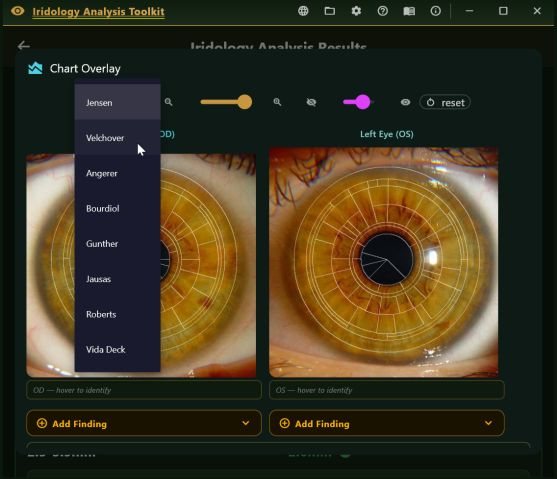
  • Eight chart overlays: Jensen, Velchover, Angerer, Bourdiol, Gunther, Jausas, Roberts and Vida Deck.
  • Pupil and collarette measurement: pupil-to-iris ratio, ellipseness, decentration and autonomic nerve wreath ratio for each eye.
  • Right and left eye comparison with bilateral metrics side by side.
  • 34 constitutional types in six groups.
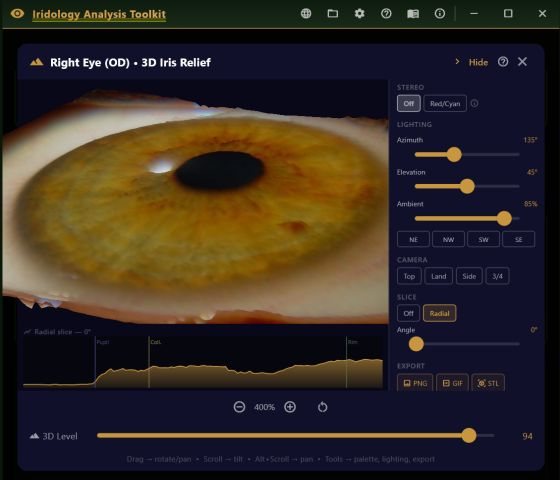
  • Image tools: enhancement, 3D iris relief, heatmap, Gabor and LBP texture views, annotation.
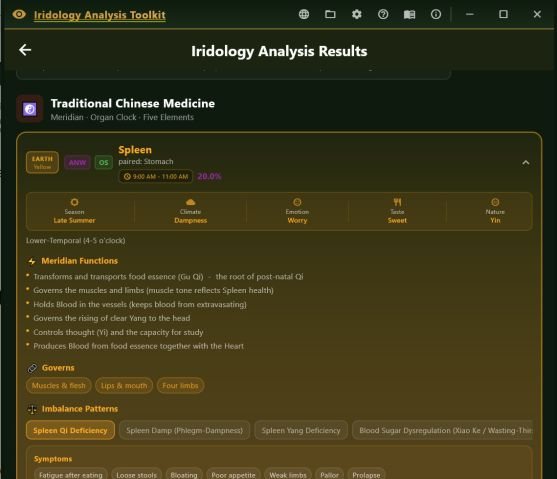
  • Reference modules for herbal, nutrition, traditional Chinese medicine and chiropractic.
  • Windows, Android, iOS and macOS, with the interface in 18 languages.

The Toolkit is sold separately at iridology-software.com. Academic membership includes a registration for Iridology Analysis Professional: one year with the annual plan, unlimited with the lifetime plan.

Visit iridology-software.com
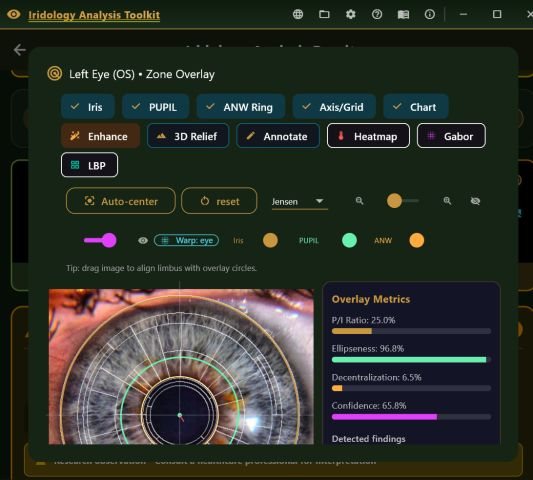
  • Zone overlay screen with iris, pupil and nerve wreath rings fitted to a photograph, Jensen chart selected, and overlay metrics.Zone overlay with measurement rings and live metrics
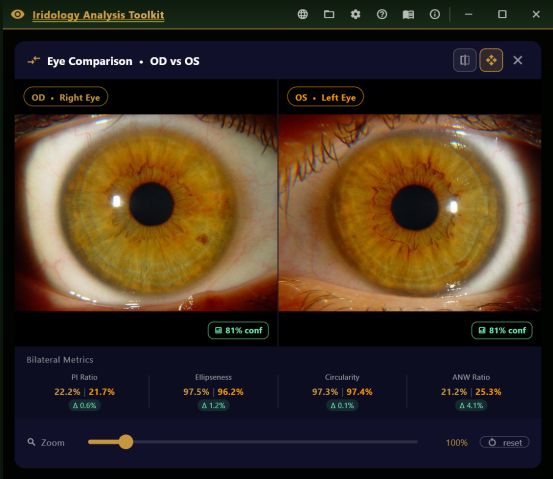
  • Eye comparison screen showing right and left eyes with bilateral pupil, ellipseness, circularity and nerve wreath ratios.OD and OS comparison
  • Chart overlay menu listing chart authors.Eight chart overlays
  • Three-dimensional relief view of a right iris with lighting and elevation controls.3D iris relief
  • Traditional Chinese medicine results for the spleen: season, climate, emotion, meridian functions and imbalance patterns.TCM reference module
Suttong Medical Systems · Windows

Virtual Bexel IRINA 2.0

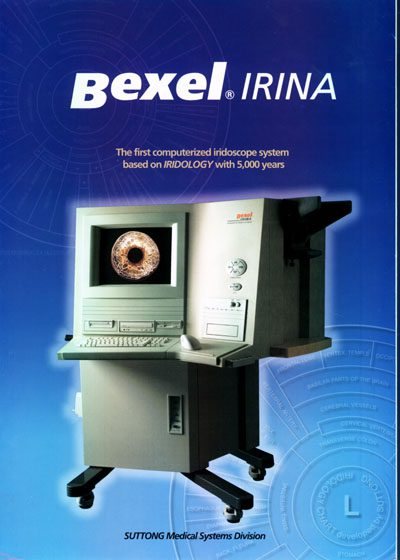
The Bexel IRINA was marketed by its maker as the first computerized iridoscope system: a cabinet workstation with a built-in iris camera and automatic analysis. Virtual Bexel Irina 2.0 brings that analysis to an ordinary Windows computer, working from your own iris photographs.

  • Pupil analysis: iris and pupil diameter, pupil-to-iris ratio, pupil distance from the iris centre, ellipse degree and deviation of the pupillary border, each checked against its normal range.
  • Autonomic nerve wreath analysis: mean diameter, perimeter, form, size of the pupillary belt and wreath asymmetry.
  • Bexel IRINA iris chart for the right and left eye.
  • In the download directory, with installation support for members.

Part of iridology's history: the Bexel IRINA brochure reported clinical test results from Korea, and members can read the original literature in the archive.

  • Virtual Bexel IRINA pupil analysis: an amber iris with the pupil outlined and a panel of iris, pupil and ellipse parameters.Pupil analysis
  • Autonomic nerve wreath analysis with the wreath traced on the iris and its measurements listed.Nerve wreath (ANW) analysis
  • Brochure cover for the Bexel IRINA computerized iridoscope system by Suttong Medical Systems Division.The original brochure
  • Virtual Bexel Irina 2.0 setup wizard welcome screen.Virtual Bexel Irina 2.0 installer
Russia · early 2000s

Russian Iridodiagnostics

Iridological analysis software used by doctors in Russia in the early 2000s. It shows how the Russian school worked in practice: paired right and left eye photographs, a chart laid over each, and structured checklists of signs, zone by zone.

  • Chart outlines over both eyes, selectable by author (Angerer shown), naming each zone under the pointer.
  • Boundary check to confirm the pupil and iris borders before analysis.
  • Morphologic signs: rosarium lymphaticum, nerve rings, arcus senilis, toxic settlements and more, with reference images.
  • Zone protocols listing the signs to look for in each zone, such as the brain zone of the ciliary belt.

Members can download it from the archive's download directory.

  • Right and left brown irises with an Angerer chart outline drawn over each and a zone named at the bottom.Chart outlines over both eyes
  • Grey-blue irises with pupil centres marked and the prompt: Are the borders OK?Border check
  • Both eyes above a row of reference iris images and a morphologic signs checklist.Morphologic signs
  • Checklist of signs for the brain zone of the ciliary belt beside thumbnails of both eyes.Zone protocols
Membership

Academic membership

Both plans open the whole archive and include a registration for Iridology Analysis Professional. Members can also contribute to the archive and earn academic credits.

One year

$95/ year

One year academic membership

  • Unlimited search of rare and translated iridology books
  • Research articles and manuscript search
  • Iris signs gallery and case study galleries
  • Video lectures
  • Iridology–Integrative Medicine Compendium
  • One year Iridology Analysis Professional registration
  • Virtual Bexel IRINA and Russian iridodiagnostic software downloads
  • Member rewards: academic credits
Join for one year
Best value

Lifetime

$495once

Lifetime academic membership

  • Unlimited search of rare and translated iridology books
  • Research articles and manuscript search
  • Iris signs gallery and case study galleries
  • Video lectures
  • Iridology–Integrative Medicine Compendium
  • Unlimited Iridology Analysis Professional registration
  • Virtual Bexel IRINA and Russian iridodiagnostic software downloads
  • Member rewards: academic credits
Join for life

Already a member? Log in. Studying with Iridology International? Lifetime membership is included in your tuition.

Academic credits

Contribute, and your membership pays for itself

Members help build the archive by adding books, papers, case studies, iris sign galleries and translations. Every accepted contribution earns academic credits.

Collect at least 50 credits during your membership year and the next year's fee is waived. Reach 150 credits for an unlimited Iridology Analysis Professional registration key.

How credits are awarded
Images and cases
Iris sign image, uploaded with a description2 each
Case study with history and both eye images+2 more with your iridological assessment or review2 each
Research and writing
Iridology abstract not already in the archive2
Translated iridology abstract5
Translated, digitized iridology book10
Book review of at least 250 words5
Current or past iridology article+2 more with your own review2
Data added to the Iridology Compendium2
Research topic page of at least 1,000 words10
Thesis-style research topic, 5,000+ wordsTopic approved by administration first30
Thesis-style research topic, 10,000+ wordsTopic approved by administration first50
Community
Approved, useful comment on an article, case or image1
Referring a colleague who registers10
Signing up for a second year10
About

Four decades of iridology research, opened to members

Iridology Research is a developmental project started by Professor Bryan K. Marcia, Ph.D., who has worked in iridological research and development since the early 1980s.

Dr. Marcia earned his Ph.D. in iridology in 1994 at the University of Health Sciences in Honolulu, where Dr. Bernard Jensen was faculty director. The archive brings together his research with material that members donate: work they have written, translated or collected that belongs to the science and practice of iridology.